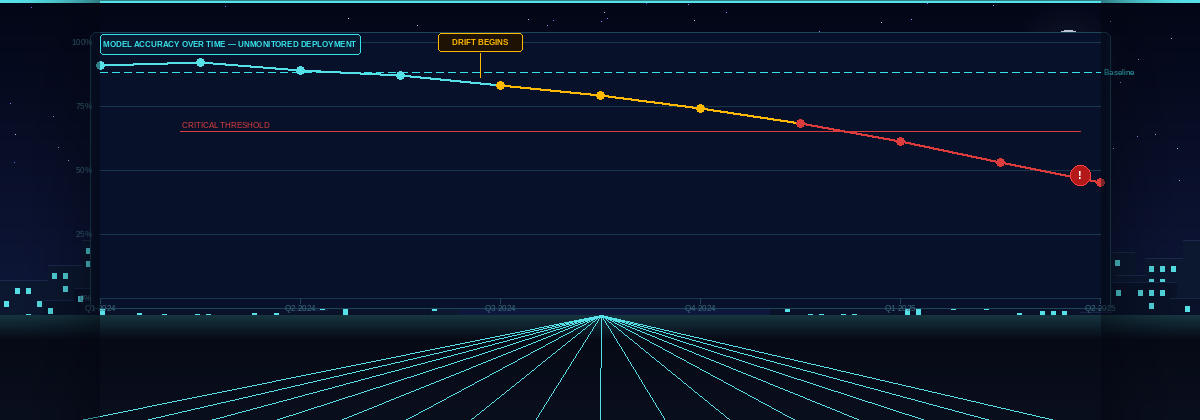
An AI system that performed well at deployment will not necessarily perform well six months later. The world changes — markets shift, customer behaviour evolves, regulations update, data patterns move — and a model trained on yesterday's reality can quietly become less reliable without anyone noticing until the damage is visible.
This is model drift. It is not a bug or a failure. It is a natural consequence of deploying systems that make predictions based on patterns that were fixed at a point in time. And in enterprise environments, where AI is increasingly touching credit decisions, compliance reviews, client communications, and operational workflows, silent drift is one of the most underestimated risks on the table.
What model drift actually is
Model drift describes the degradation of an AI system's performance over time as the relationship between inputs and outputs shifts away from what the model was trained on. There are two main forms:
Why drift is invisible until it is serious
The insidious quality of model drift is that it rarely announces itself. There is no error message, no system alert, no failed transaction. The model continues to produce outputs — they just become progressively less reliable, less relevant, or less accurate, at a rate that is too gradual to trigger immediate concern.
In financial services, a credit risk model that drifted gradually over two quarters might still be producing outputs within a plausible range — just not the right ones. In a legal document review system, outputs may still look grammatically reasonable even as the model misses the conceptual substance that matters for compliance. In both cases, the drift only becomes visible when an auditor, a client, or a regulator asks why a decision was made.
"AI that worked last quarter may not work this quarter. The system does not know it is drifting — and neither does anyone else, unless someone is specifically looking."
The business conditions that accelerate drift
Certain environments are more prone to rapid model drift than others. Organisations should pay particular attention when:
- Regulatory requirements change — new obligations alter what counts as compliant, invalidating previous training data
- Market conditions shift rapidly — post-crisis, post-merger, or post-pandemic environments generate data patterns unlike anything the model trained on
- Product or service offerings evolve — new product types, new client segments, or new geographies introduce inputs the model was never exposed to
- Data sources are updated — supplier changes, system migrations, or schema updates alter the upstream data pipeline
- User behaviour changes — prompting patterns shift as staff becomes more or less AI-literate, changing the distribution of inputs
In each of these cases, the model is not broken — it is simply operating outside the conditions it was designed for. And without active monitoring, this will not be caught until the consequences become difficult to ignore.
What monitoring actually requires
Effective drift monitoring is not a single metric or a quarterly report. It is a continuous process with several components:
Version control as a governance requirement
Model versioning is not just a technical convenience. In regulated industries, it is a governance obligation. If a model changes — even a minor update to weights, parameters, or training data — and a decision made under the previous version is later challenged, the organisation needs to be able to demonstrate which version made that decision, and why it was considered appropriate at the time.
This requires more than a version number. It requires a full record of the training data used, the evaluation metrics at deployment, the date of deployment, any known limitations, and the decision to approve it for production use. Without this record, a model update is an undocumented governance event — even if the technical change was minor.
Responsible retraining
Retraining a model is not a simple fix. Done without care, it introduces new risks: overfitting to recent data, loss of performance on edge cases the original model had learned to handle, or introduction of new biases from a changed training set.
Responsible retraining requires:
- A defined trigger — not "the model seems slower" but a measurable threshold breach
- A controlled training environment — separate from production, with validation before deployment
- A comparison protocol — the new version must demonstrably outperform the old on a held-out validation set before it replaces the live model
- A rollback plan — if the new version underperforms after deployment, the previous version must be restorable without delay
- A governance record — the retraining event, the rationale, and the validation results are documented and retained
SeldonIA's architecture supports model versioning and controlled retraining within the customer's own infrastructure. Because the entire system — including logs, embeddings, and model artefacts — remains inside the compliance perimeter, retraining events are recorded, attributable, and subject to the same governance controls as the original deployment.
"The question is not whether your AI model will drift. It will. The question is whether you will know about it before your clients, auditors, or regulators do."
Building drift into your review cycle
For most enterprises, the practical starting point is not a full MLOps platform — it is a defined review cadence. At minimum, every AI system in production should be subject to:
- Quarterly performance reviews against baseline metrics established at deployment
- A documented assessment of whether business conditions have changed materially since the last review
- A named owner responsible for triggering a retraining review if thresholds are breached
- A documented record of each review, its findings, and any actions taken
This is not technically complex. But it requires someone to own it — and that ownership question leads directly back to the governance model that makes AI sustainable over time.